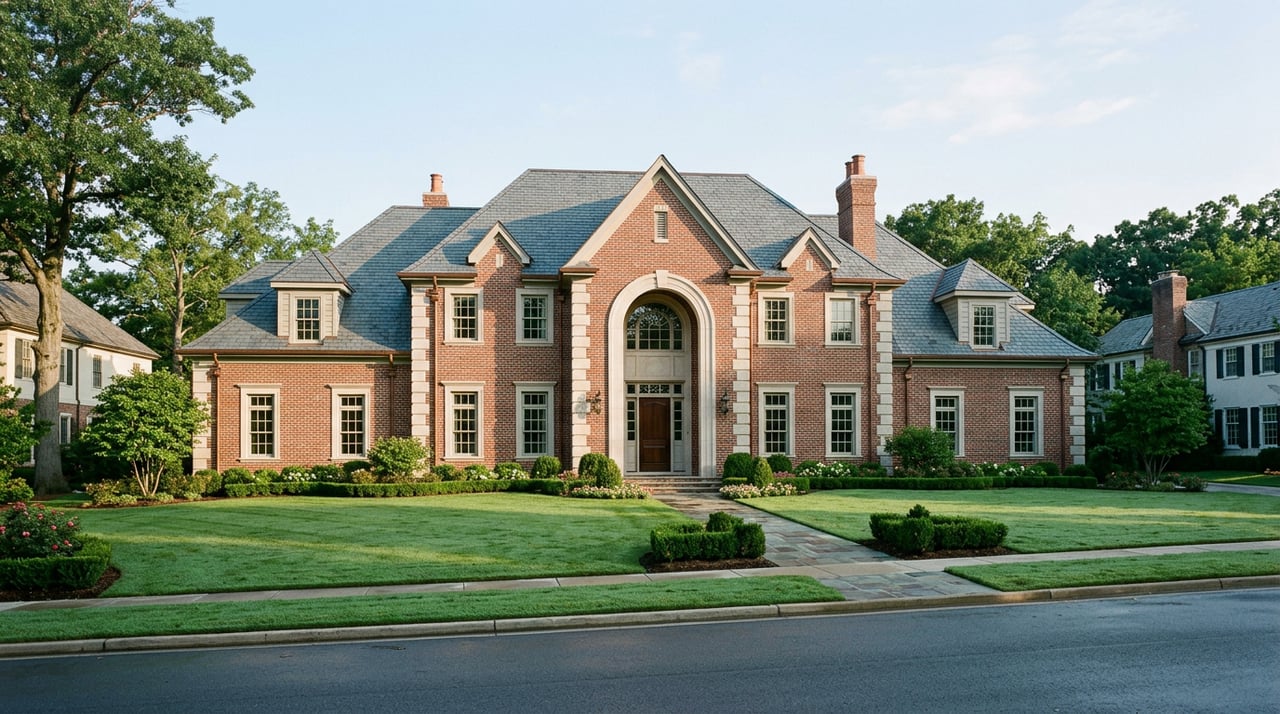

The Summerfield search on any national portal returns a median that looks straightforward. In May 2026 it sat near $662,000 at roughly $229 per square foot, with homes averaging 44 days on market. A twelve-month view from a different source put the same market closer to $706,000 with a reported year-over-year jump north of 20 percent. Both numbers are technically correct. Neither describes what a buyer actually pays here, or what they own five years from closing.
Two mechanisms explain the gap, and both live outside the listing photos. The first is the well-and-septic math baked into almost every home priced above $500,000 in the 27358 zip code. The second is a nearly 1,000-acre carve-out at the geographic heart of town that state lawmakers pulled out of Summerfield's jurisdiction in 2024 and handed to Greensboro and Guilford County. If you are comparing Summerfield to Oak Ridge or Stokesdale on price per square foot, you are missing the two things that will determine your outcome.
The friction that shows up after the offer
Summerfield has no municipal sewer serving most of its residential stock. The town covers about 27 square miles with roughly 11,100 residents, and the housing pattern that grew up here since incorporation in 1996 depends on private wells and on-site septic systems. Median parcel size for land currently listed sits at 1.03 acres, and the reason is not aesthetic preference. It is what a conventional drain field, a required replacement drain field, and the setbacks between a well and a septic tank actually consume on the ground.
For a move-up buyer coming from an in-town Greensboro neighborhood on city services, that translates into a small pile of transaction items that never appear in the price per square foot:
- A perc test contingency on any lot without a current one on file. Several Summerfield listings advertise the perc test as a feature, which tells you how much friction its absence creates.
- A septic inspection separate from the general home inspection, usually with the tank pumped as part of the process.
- A well flow and water quality test. Bacteria, nitrates, and, on older properties, iron and manganese all show up in the report.
- A survey of the drain field and its designated repair area, because the repair area governs where you can eventually add a pool, an accessory building, or a driveway extension.
None of that reprices the house on its own. What it does is compress the negotiation window and shift where the money goes at closing. A 20-year-old system with an undersized tank on a 1.2-acre lot is not the same asset as a 5-year-old system with a full replacement field mapped and recorded, even if the two homes list at the same number. Buyers who learn this after the due diligence period has started tend to overpay for the older system or walk from the older home entirely, and both outcomes distort the comp set that shows up on the portals next month.
The same math runs in reverse for sellers. A Summerfield homeowner who has documentation of a recent septic pump, a current well test, and a clean drain field survey is selling a materially different property from the neighbor two doors down who does not. In a market where Homes.com shows homes averaging 156 days on market against Movoto's 44, the spread is doing work. The fast half of the market is homes where the friction is already resolved.
Why the portal medians are drifting apart
Small samples and wide price dispersion are doing more to the reported figures than actual price movement is. Consider the mid-2026 snapshot across four sources:
- Movoto, May 2026: median list $662,000, 44 days on market.
- Homes.com, trailing twelve months: median sale $706,310, reported up 24 percent year over year.
- Rocket Homes, April 2025 baseline: median sale $611,000, up 6.4 percent year over year at that point.
- Land, June 2026: median parcel 1.03 acres, median list $89,900 with an average close to $135,000, and per-acre pricing that varies by an order of magnitude depending on whether the lot is inside a covenanted community or on unrestricted acreage.
A 24 percent year-over-year jump in a market this thin usually means the mix shifted, not that individual homes appreciated at anything close to that rate. Recently sold values in the 27358 zip code have run from roughly $73,000 to more than $1.36 million in the same window, and closings often cluster at the upper end during the spring and summer stretch. When two custom homes on three acres each close in a quarter that would otherwise have seen a few smaller resales, the median moves in a way that has nothing to do with what the reader's target house is worth.
The practical read for a buyer: price your target by the sub-market inside Summerfield, not by the town median. A brick ranch on a covenanted acre in Lennox Woods with pool and sport-court amenities, a custom estate in The Vineyards on nearly three acres, a 1970s renovation candidate on unrestricted land, and a 2026 new build on 0.73 acre with a $125-per-month HOA are four different products. The town median averages them and hands you a number that does not describe any of them.
The variable that changes the medium-term thesis
Now the 1,000-acre question. In June 2024, the North Carolina legislature approved House Bill 909, which de-annexed nearly 1,000 acres of David Couch's land out of Summerfield. As of June 30 that year, the land became unincorporated Guilford County. In March 2025, the City of Greensboro annexed and rezoned the first 78.7 acres of that property, a piece near Lake Higgins at Carlson Dairy Road and Hamburg Mill Road. That piece is called Christopher Village, and it is planned for 268 dwellings across single-family homes, rowhouses, live/work units, apartments, and accessory dwellings.
Christopher Village is the first of eleven. On August 18, 2025, Couch's team presented the full Villages of Summerfield Farms plan to Greensboro's Planning and Zoning Commission: roughly 5,000 housing units over a 30-year build-out, designed by Victor Dover of Dover, Kohl & Partners, developed by Blue Ridge Companies. Couch has said publicly that ultimate pricing would range from the $300,000s into the multi-millions. Water and sewer for the project remain in discussion among Greensboro, Forsyth County, and Rockingham County.
Whatever a buyer thinks about the project on the merits, three things follow for the Summerfield housing decision:
- The land in question sits inside the geographic town but no longer under its zoning authority. The mailing address may read Summerfield for many of the new units, while the entitlements, tax base, and services flow to Greensboro or the county. That is a materially different arrangement than the rest of the town, and it will affect resale narratives on adjacent properties.
- This is the first substantial supply of attached and denser housing types in a market whose price structure was built entirely on detached homes on acre-plus lots. A first-time attached product priced from the $300,000s does not compete with a $700,000 custom home, but it changes the school-district entry point and the composition of buyers touring nearby.
- The build-out is measured in decades, not seasons. Christopher Village construction was targeted to begin in 2026. The remaining ten villages have no fixed schedule. A buyer purchasing an established Summerfield home this year should assume the surrounding streetscape at year five looks similar to today, and the streetscape at year fifteen probably does not.
For a buyer choosing between an established Summerfield home and a new build on the northwest side of Greensboro, that horizon matters. For a seller pricing an acre-lot home within a mile of Lake Higgins, it matters more.
How the two mechanisms combine
The friction and the supply variable are not independent. Buyers who understand the well-and-septic math tend to bid more aggressively on homes with documented systems and pass on homes without. Buyers who understand the Couch project tend to weight proximity to preserved open space, covenanted acreage in communities like Birkhaven Reserve, Autumn Creek, and Rivers Edge, and Northern Guilford school assignment more heavily than the raw price per square foot suggests. Together, those preferences pull the sub-market for well-documented, covenant-protected acre lots away from the sub-market for undocumented systems or lots near planned density.
The town median averages both sub-markets into one number. The portal shows you that number. The house you actually buy behaves like one of the two.
If you are within a season of a purchase or a listing here, the answer is not to memorize a median. It is to pull the specific documents that resolve the friction: the septic permit, the well log, the plat with the repair area shown, the HOA covenants if any, and the current Guilford County parcel record. Priced against those, most Summerfield homes will read either as undervalued or overvalued relative to the surface number, and the reason will be visible.
The team at Carolina Home Partners works these files every week across Summerfield, Oak Ridge, and the wider northwest Guilford band, and we can pull the septic and well history on any address you are watching before you write an offer. If you are on the sell side, the same review turns a slow 156-day listing into the fast 44-day version. Start with a free home valuation, or reach out and we will meet you at the property.